Mainstreaming Civil Society Participation at the Annual Meetings

Photo:  Nazanine Atabaki

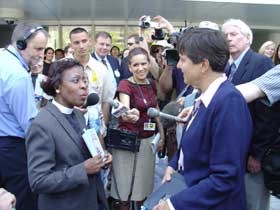
The participation of civil society representatives at the World Bank and IMF’s Annual Meetings, which brings together the world’s finance ministers to discuss international development policy, has grown steadily over the past six years.  The most recent Annual Meeting, held in October 2011, saw the largest CSO participation to date, with a total of 600 CSO representatives from 85 countries in attendance. They represented a variety of civil society constituencies: non-governmental organizations, youth groups, foundations, faith-based groups, and trade unions.  They came to discuss a broad range of issues ranging from financial transactions tax and aid effectiveness, to energy policy.  In order to ensure that Southern CSO voices are also heard, the Bank and Fund sponsored 60 CSO and Youth Leaders from developing countries to participate in the Meetings.

CSOs participated in the Civil Society Program which included an orientation session on the World Bank and IMF, Civil Society Policy Forum, and participation in the Program of Seminars. The CS Policy Forum, held on September 21 – 24, comprised over 50 policy sessions on a wide range of topics.  There were substantive and constructive sessions organized by World Bank and IMF units, but the majority was organized by policy advocacy CSOs such as Bank Information Center (BIC), Oxfam, World Resources Institute, and Global Witness on such topics as aid effectiveness, extractive energy, disaster management, and the financial transactions tax.

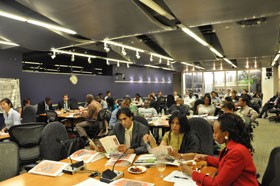
Two highlights of the CSO Program were the CSO Roundtable with Executive Directors and the CSO Townhall with Mr. Robert Zoellick and Ms. Christine Lagarde.  The CSO Roundtable had the participation of some 80 CSO representatives and 20 Executive Directors or alternates from the WBG and IMF.  The CSO Townhall had some 250 CSO representatives in attendance.  It was chaired by Ms. Ingrid Srinath, Secretary General of Civicus, and two CSO discussants – Ms. Laila Iskandar from Egypt, and Ms. Milwida Guevara from the Philippines – provided initial remarks.  The main issues discussed at the Townhall were steps taken by the Bank and Fund to respond to the global economic crisis, Bank’s energy policies, and ways the Bank can work more closely with civil society.

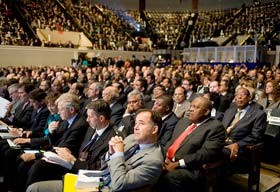
The Bank undertook several steps this year to mainstream CSO participation in the broader Meetings.  This included: organizing bilateral meetings for sponsored CSOs with all six regional Vice Presidents or senior managers; organizing the CSO Roundtable with EDs; and inviting 80 CSO and Youth Leaders to attend the Opening Plenary.  It is clear that the growing  participation of civil society in the Annual Meetings enriches the event by allowing new and often critical voices and perspectives on the major issues to be heard.
The Bank’s New Social Contract with Civil Society

Photo:  © Simone D. McCourtie /World Bank (on Flickr)

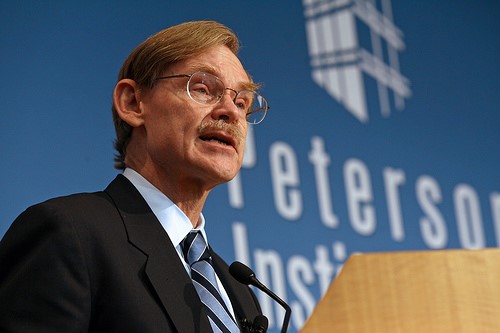
The recent democratic uprisings in the Middle East served as the backdrop for a major speech given by Bank President Robert Zoellick on the emerging role of civil society.  The speech, The Middle East and North Africa: A New Social Contract for Development  given at Washington’s Peterson Institute on April 6, may well mark a watershed in Bank – civil society relations.  He stated that “now it may be time to invest in the private, not-for-profit sector – civil society — to help strengthen the capacity of organizations working on transparency, accountability, and service delivery.”  Mr. Zoellick further said that “in one way or the other, a modernized multilateralism needs to recognize that investments in civil society and social accountability will be as important to development in the Middle East and beyond as investments in infrastructure, firms, factories, or farms.”

A quick review of World Bank history shows that as the Bank realized in 1956 that it needed to partner with the private sector in order to promote economic growth in developing countries, it established the International Finance Corporation (IFC) to invest in companies.  The Bank may be in a similar historic juncture regarding the indispensable role civil society plays in promoting social development, environmental protection, and good governance worldwide, and realizes that it must now engage civil society as it did the private sector earlier.

In some ways, Mr. Zoellick formally recognized what the Bank has learned over the past several decades.  As he stated, “a robust civil society can check on budgets, seek and publish information, challenge stifling bureaucracies, protect private property, and monitor service delivery.”  The Bank learned, for instance, that international and local NGOs play an indispensable role in disaster recovery by partnering with them in Indonesia after the 2004 tsunami. The Bank realized that the most effective way to combat HIV/AIDS at the community level is to involve local civil society, and for this reason the Bank has channeled over $400 million dollars to CSOs in 28 African countries through its Multi-Country AIDS Program (MAP).   More recently it has learned that by supporting such CSO-led instruments as participatory budgeting, citizens score cards, and budget tracking, it can help to promote better governance and improved government services.

While it is difficult to know what policy and programmatic changes this speech will usher in, it is clear that CSOs have already taken note.  Sam Worthington, the head of InterAction, stated that “the speech was a real breakthrough for us in the NGO world”.   “Mr. Zoellick said what we have known all along, that when civil society groups participate in the design, monitoring and management of public services, budgets are better used and there is less corruption.”  There is growing consensus that the Bank has advanced significantly in the openness and quality of its policy dialogue and consultation with civil society.  What this speech seems to reflect is the realization that what is needed now is a scaling up of its operational collaboration with CSOs.  Whether this will result in greater CSO involvement in projects at the country level or even new funding mechanisms is difficult to predict, but it is likely that we will look back at Zoellick’s speech as an important milestone in the Bank’s evolving relations with civil society.

Civil Society Finds its Voice in Tahrir Square

Jonathan Rashad (on Flickr)

While it may take historians years to understand the historic conditions and political factors which triggered the democratic revolution in Tunisia, Egypt, and other countries in the Middle East, one thing seems to be certain.  The political actor which has gained the most prominence in these political uprisings has been ‘civil society’. This term encompasses the large sector within any given society which sits between governments and the for-profit or private sector.  As such it includes youth movements, workers unions, NGOs, political parties, and faith-based organizations among others.  It is a term still little understood, often derided by authoritarian governments, and rarely heard in the Middle East until now. The term in Arabic is “mojtama’a madani” and has the same broad meaning as in English.  It is said that when Egyptian ex-President Mubarak first heard the term he mockingly quipped, “So what’s wrong with military society?”

A good indication of how visible and prominent the civil society term has become is how often it is being repeated by CNN and Al Jazeera pundits and political leaders such as British Prime Minister Cameron and Secretary of State Clinton.  As a matter of fact, Secretary Clinton took advantage of the events in the Arab world to hold a first ever “Strategic Dialogue with Civil Society” on February 16 at the State Department.  She was joined by civil-society representatives from more than 20 countries and thousands more who participated in the event through videoconferences in 50 countries.  She stated that if “we’re going to take advantage of this historic moment (in the Middle East), we have to tap the expertise, experience, and energy of civil society”.  She also noted that both she and President Obama “have deep personal connections to civil society. He began his career as a community organizer; I began mine as an advocate for women and children’s rights. Both of us are committed to defending civil society”.

Egyptian activist Sherif Mansour, who was also present at the State Department event, added that the uprisings in his country can only be “attributed to people in Egypt and Tunisia who proved that ultimately civil society is a change-maker and the permanent partners for the U.S. in the long run”.  Other prominent global civil society leaders have also noted the emergence of civil society in the Arab world.  Ingrid Srinath, Secretary General of Civicus, stated in a recent article that the only path to stability in the region “are grounded in the rights to freedom of association, expression and assembly so that civil society can play its entire spectrum of roles” including promoting free speech, organize peacefully and hold governments to account.

At the World Bank we have increasingly come to realize how important civil society is, and that is why we actively engage CSOs through policy consultations, joint research, grant funding, and operational collaboration. While we increasingly engaged civil society over the past decade in the Middle East, the recent events will certainly accelerate this process.  As Shamshad Akhtar, World Bank Vice President for the Middle East, said at a speech in Brussels on February 23: “The democratic movements provide a unique opportunity to leverage people and civil society power to change the landscape of the Middle East and North Africa”.

Bashing the Bank: Assessing the Efficacy of CSO Advocacy

Photo:  Civil Society Team

CSOs have been targeting the World Bank Group for 25 years in an effort to influence its economic, social, and environmental policies.  Many of these advocacy campaigns have been quite contentious and critical over the years, the most visible being the ‘50 Years is Enough” campaign of the 1990s which called for the abolishment of the Bank.  While this particular campaign was obviously not successful, it is clear that some of the most important Bank reforms adopted over the years – environmental safeguards, compliance mechanisms, and access to information – were spearheaded by civil society.

Building on this long advocacy tradition, an increasing number of Bank-watcher CSOs are undertaking external evaluations to assess and improve the impact of their efforts.  These have included the Bank Information Center (BIC) in Washington, Bretton Woods Project  (BWP) in London, and Both Ends in Amsterdam. These advocacy assessments followed similar methodologies including retrospective analysis of Bank policies and interviews with key interlocutors such as government officials, donor agency representatives, and even Bank staff.  Even though these assessments focused on differing policy areas, they reached similar conclusions.  First, that advocacy CSOs need to sharpen their analysis on specific Bank policies and programs.  Second, while civil society advocacy has been successful in some areas, CSOs shouldn’t over estimate the policy impact they can have more generally.   Third, CSOs need to build more rapport with Bank managers and staff in order to achieve their advocacy goals.

In addition to the assessments, CSOs have continued to publish handbooks and guides geared to improving the efficacy of their advocacy efforts on the Bank.  The most recent of these is a toolkit published by BIC titled Executive Director Advocacy Toolkit: A Guide to Influencing the World Bank Board of Directors.  The publication examines the role of Executive Directors, suggests ways to approach EDs, and shows how to design advocacy campaigns.  The guide provides specific advice on how to influence EDs.  It states, for instance, that activists should make clear that they are not going to “surprise or attack” EDs but want to have a constructive dialogue. This means that CSOs need to “go beyond rhetorical positions and criticisms of the Bank” and present evidence for their positions and propose solutions to problems.   In a nod to pragmatism, the guide reminds activist that “there are no permanent allies and no permanent enemies” in this policy arena. Even if EDs have opposed your positions in the past, “there are always opportunities to work together positively in the future”.

These evaluations and guides demonstrate that advocacy CSOs are becoming more savvy and effective about influencing policies at the Bank Group.   The fact that they sought out Bank staff views on the quality of their advocacy efforts, also shows that they are more confident and willing to more closely engage the Bank.


Training with the Enemy: How CSOs Are Improving Bank Staff’s Ability to Engage with Civil Society

Photo:  Civil Society Team

While some Bank and CSO staff may have considered each other ‘enemy combatants’ on the proverbial policy battlefield some years back, today many are collaborating in joint training efforts geared to improving relations.  In a reversal of roles, a number of policy advocacy CSOs are helping to train the very same Bank staff whom they often advocated against in the past.  A good example is the participation of well known CSOs who monitor transparency issues in the extractive industries – Global Witness, Oxfam, and Revenue Watch – in a training session with staff from the Bank’s Oil, Gas, and Mining Department in April 2010.  The session was geared to improving the Bank staff’s knowledge and skills to engage civil society, and the CSOs were asked to both diagnose the nature of Bank – CSO tensions and suggest ways to improve these relations. While CSOs highlighted the difficulty they often face to get information or set up meetings with Bank staff, they also noted how the Bank’s presence can actually guarantee the safety of local CSOs.  Bank staff, in turn, shared the difficulty they have in identifying the appropriate CSOs to engage with at the country level, and expressed frustration with some of the critique the Bank receives despite their efforts to reach out.  They also welcomed greater civil society involvement in Bank-financed extractive industry projects.

Another instance of CSO involvement in training of Bank staff was a series of capacity-building sessions by the Middle East and North Africa (MNA) region, held in January – February 2010. The training course focused on improving the quality of civil society engagement in the MNA region and was one of the initiatives undertaken in response to the Yemeni Inspection Panel Case. The four half-day training sessions were offered to all MNA operational staff based in Washington, and representatives from the Bank Information Center (BIC), World Learning, and the International Trade Union Confederation (ITUC) participated in panel discussions during each the sessions. The CSO representatives provided insight into how they view their role vis-à-vis the Bank, and gave examples of what they think has worked well and not so well in their engagement with the World Bank.  Bank staff who participated in the four training sessions gave their highest survey marks for the CSO panels.

Finally, World Learning which is a CSO with decade’s long experience carrying out community-based training worldwide, has been assisting the Bank over the past 5 years to provide training to Bank staff on engaging civil society.  They help the Civil Society Team deliver 3 day-long courses “Civil Society: Why and How to Engage Effectively” to Bank staff on why (rationale, theoretical basis) and how (methodology, tools) to engage civil society.  The interactive course includes: presentations on the history of Bank – CSO engagement and the Civil Society Consultation Sourcebook; a simulation of a conflictive Bank – CSO consultation meeting; and group work on developing effective engagement strategies within actual Bank projects.

This new found collaboration around training not only defies stereotypes, but is further evidence of how far Bank – CSO relations have evolved in the last 20 years.  What these training courses have shown that there is much to be gained by Bank and CSOs exchanging perspectives and experiences in order to improve the effectiveness of their respective engagement efforts.  This does not mean that the Bank and CSOs will agree on all issues, but they will at least be able to communicate better and hopefully build greater trust going forward.

Web story on MENA Sessions

Civil Society Consultation Sourcebook

Are CSOs Welcome at the World Bank?

Photo:  Civil Society Team

This question may have been hard to respond in the affirmative some years back, as Civil Society Organization representatives were still a rare sight at the Bank. It may be hard to believe today, but 20 years ago visiting CSOs had to be physically escorted throughout the buildings, and it was not uncommon for some CSOs to be refused entry. Today, CSOs are actively welcomed and some even have long-term building passes to facilitate their daily meetings at the Bank. As a matter of fact, the recently concluded Annual Meetings represented a milestone for CSO presence at the Bank. Not only was it the largest gathering of CSOs in a Washington-based AMs, but CSO leaders were invited, for the first time, to participate in the official Opening Plenary.

A total of 400 civil society representatives from over 62 countries attended the AMs (see list of accredited participants). As in past years, the Bank and Fund also sponsored CSO representatives from developing countries to attend in order to ensure that Southern voices and perspectives were well represented. A total of 37 CSO Fellows came from 32 countries and represented a variety of organizations (i.e. NGOs, trade unions, think-thanks, and faith-based groups) and thematic areas (education, environment, youth, economic development, and governance). (see list of CSO Fellows)

CSO representatives also participated actively and/or hosted a number of policy dialogue sessions during the Civil Society Policy Forum (CS Forum) which was held from October 6 – 10 and comprised 50 sessions. CSOs held numerous bilateral meetings with Bank Executive Directors, senior managers (Vice Presidents), and regional staff. CSOs also had an opportunity to engage with WBG President, Robert Zoellick and IMF Managing Director Strauss-Khan at the CSO Townhall and Reception which has become a traditional feature of the Annual Meetings.

The most significant indication, however, of how open the Bank’s doors are for CSOs was the fact that a group of 25 CSO leaders were invited to attend the Opening Plenary of the Annual Meetings. This event, headlined by the 187 Finance Ministers, featured speeches by the Bank President and IMF Managing Director. When asked about the significance of having been invited to attend, Peter Bakvis of the International Trade Union Confederation (ITUC) stated that “We are pleased that the WB and IMF have, for the first time, invited civil society representatives as observers to this official event as a sign of greater openness. Increased transparency allows the institutions to get better feedback from constituencies affected by their policies and helps CSOs be more effective in their monitoring role.”

Agreeing to Disagree on the Blogosphere: Blogs Providing Conducive Venue for Bank – CSO Policy Dialogue

Photo:  Civil Society Team

There is growing Bank – CSO policy dialogue occurring via blogs which is generating unexpected thoughtful and frank exchange of views. The most recent case was a few weeks back when Justin Lin, the World Bank’s Chief Economist, was invited to be a guest blogger on the “From Poverty to Power” blog page maintained by Oxfam/GB’s Head of Research, Duncan Green. The exchange was on Justin’s recent paper “Growth Identification and Facilitation” on the role governments play in promoting economic growth. Many CSOs, such as Oxfam, feel that the Bank is undergoing a paradigm shift by now providing developing countries with more ‘policy space’ to design their own economic plans, including industrial policies to support nascent industries.

This exchange follows an earlier blog interaction between Shanta Devarajan (Chief Economist for the Bank’s Africa Region) who hosts the Africa Can…End Poverty blog, and Barbara Stocking (the CEO of Oxfam/GB) on the Africa region’s “Quiet Corruption” paper. Rather than responding privately to a letter sent by Barbara on the report, which would have been the traditional way of engaging with Oxfam, Shanta posted both her letter and his response on the blog and invited others to comment. The debate hinged on whether it is appropriate to label pervasive absenteeism and low productivity by public education and health workers in the Africa region as a form of ‘corruption’ or whether these workers are ‘victims’ of poorly financed and managed government service delivery programs. The Bank is also using blogs to engage CSOs around the contentious issue of climate change. Athena Ballasteros, Senior Associate at World Resources Institute, has been invited to be a guest blogger on Bank’s Development in Changing Climate blog page. There she joins Bank staff and academics debating whether the Bank’s proposed new energy strategy and climate change investments truly represent a paradigm shift to a low-carbon development model or whether it is too soon to draw such a conclusion.
What this recent policy dialogue between the Bank and Oxfam seems to demonstrate is that the blogosphere is beginning to provide a useful venue for policy engagement between and Bank and its CSO interlocutors. Rather than using the media, which has been a traditional way for CSOs to engage the Bank and for the Bank to respond, blogs allow for less official and confrontation response. Since Bank staff are generally responding in their own names it allows them to be both less defensive (they don’t have the burden of responding for the institution), but also be more direct and frank in their response. In addition, blogs encourage and allow third party voices to be brought into the discussion. This was the case, for instance, in the exchange on the quiet corruption report which generated a number of comments and responses from Africa.

In short, these blog exchanges seem to be introducing the possibility for more frank and informal policy dialogue, which is also more collegial in tone. What this experience seems to be showing is that social media, with its podcasts, blogs and tweets, has the potential of scaling-up and improving the quality of Bank – CSO dialogue going forward.

Bridge over Troubled Waters: Navigating the Policy Divide

Photo:  Civil Society Team

The World Bank has been engaging a wide variety of policy advocacy CSOs on the issues of access, rights, and financing of urban water and sanitation programs over the past five years. Of particular concern to CSOs have been the issues of water privatization, cost-recovery approaches, and lack of affordable water services for low income populations in Bank-financed water and sanitation projects. For its part, the Bank has welcomed this dialogue because it clearly shares with civil society the goal of extending universal coverage to the poor in developing countries and improving delivery effectiveness. Within this context, the Bank has undertaken a watershed process of meetings and joint research with leading NGOs, trade unions, and research centers. The Bank’s most significant civil society interlocutor to emerge during this period has been the Freshwater Action Network (FAN), which is an international coalition of several hundred CSOs in Africa, Asia, and Latin America who work on water and sanitation issues.

Engagement activities have included a two-day workshop on urban water and sanitation during the World Bank Water Week in February 2007 in Washington, DC, a Political Café discussion on the right to water during the Annual Meetings in October 2008 (see photo), and a “scoping study” on how to promote more systematic dialogue on water and sanitation issues.  The “FAN–World Bank Scoping Study about Developing Dialogue between the World Bank and Civil Society Organizations about Urban Water and Sanitation Services”,  which was carried out by Public World, was a thorough and thoughtful analysis of the characteristics, constraints, and opportunities for Bank-CSO engagement on the issue of water. More recently, FAN and the Bank have been working on several research products including developing a “handbook” for CSOs on how to engage the Bank around water policies, and producing a “guidance note” for Bank staff on how to engage civil society.  Both are geared to generate lessons and encourage greater Bank, government, and civil society engagement.  The most recent initiative was a video conference held on April 21, 2010 between several dozen FAN members and Bank managers / staff to discuss the draft handbook and guidance note.

The promising and intriguing aspect of this initiative is that water has always been one of the most controversial and complex issues for Bank – CSO policy dialogue.  One only need remember the citizen protests in Cochabamba, Bolivia when the system was privatized a few years ago, which many attributed to the Bank even though it was not directly involved in the decision.  What has made this dialogue so challenging is that it has tried to bridge the views of water as both a human right and a service which must be financed.   While there are still some disagreements, this carefully constructed process of dialogue and joint research has already resulted in a better understanding of each other’s roles in advocating for and financing water services.  The hope is that this engagement process will eventually lead to greater government – civil society collaboration at the country level geared to promoting affordable and clean water for the poor.

FAN Webpage on Bank – CSO Engagement